Thoriso Watson — Emergent Systems Research
Project Proteus
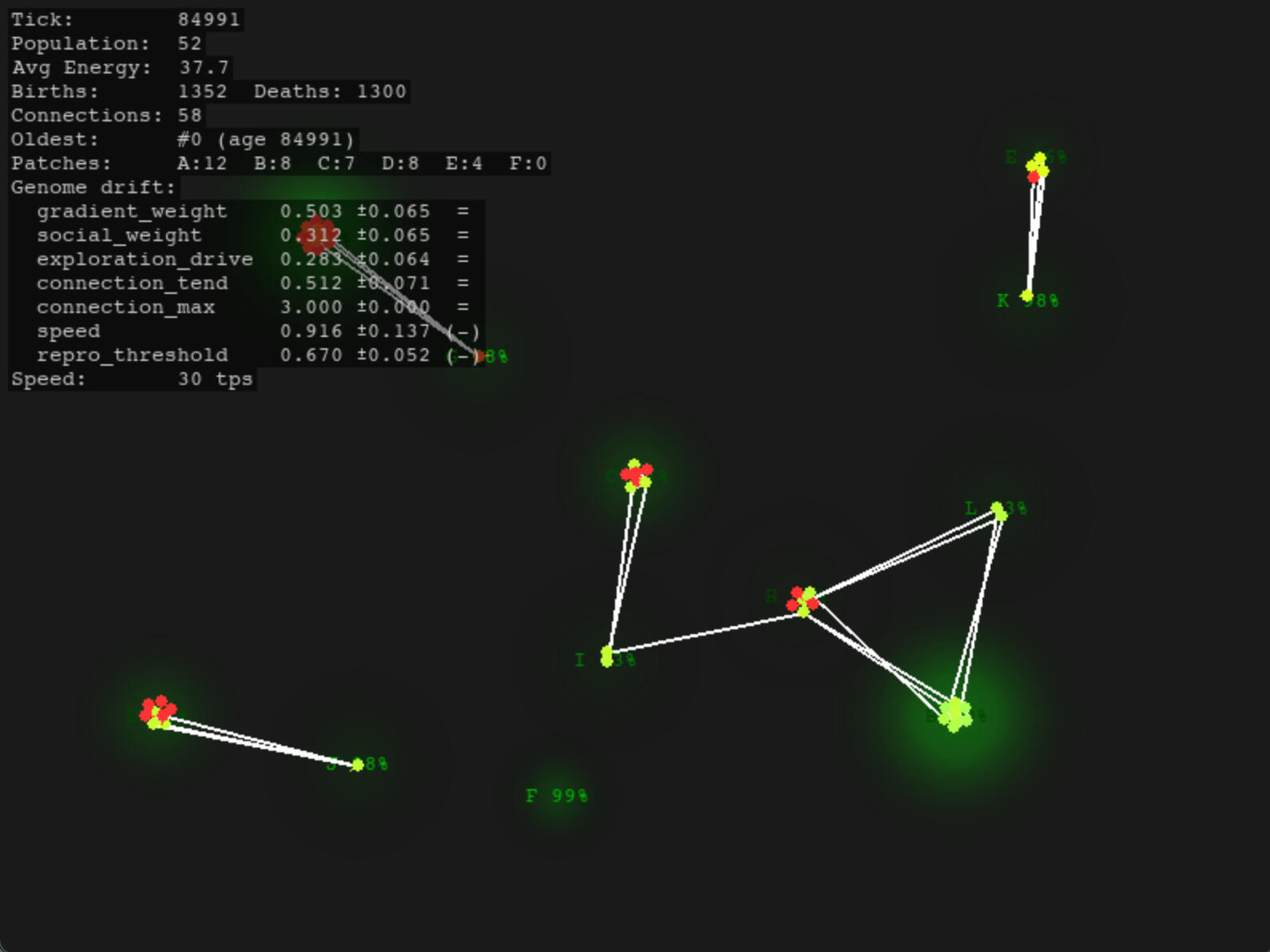
Proteus is an artificial life simulation, aiming for open ended evolutionary behavior. Each circle represents an autonomous node, where red is low energy and green is high energy.Emergent Relay Networks
Nodes acquire energy from resource patches (A-L) and consume energy with time, connections, and movement. The relay networks visible here are emergent — no node was programmed to form networks, relay energy, or occupy specific positions. These structures self-assembled through evolutionary dynamics alone.Connections between nodes develop directional memory from repeated use. A connection that habitually carries energy in one direction becomes more efficient in that direction over time — analogous to long-term potentiation in biological neural networks, where neurons that fire together wire together. This capacity for directional memory is built into the connection system. Which connections develop it, and in which direction, is determined entirely by the energy flow patterns that emerge from evolutionary dynamics.Behavior, as a whole, is modulated by the seven genes featured in the simulation HUD
Vision
The proteus vision is to explore whether energy economics alone can produce self-organizing distributed intelligence.
The Evolutionary Result

Across ten independent runs and five million ticks, two of the seven genes show consistent directional drift: speed and reproduction threshold. Both trended below their default values while the remaining five genes held stable.This indicates selection pressure for earlier reproduction and reduced movement cost — on average, nodes that move slower and reproduce sooner outcompete those that don't. The other five genes are holding near their default values, meaning there is little selective pressure acting on them.
Sustained Genetic Diversity

This heat map shows within-population genetic diversity across all seven genes over 5 million ticks, averaged across 10 runs.Connection Max maintains high diversity throughout — the population never converges on a single connection strategy. Speed and Reproduction Threshold show moderate diversity consistent with active selection. The remaining four genes remain near-uniform, confirming that selective pressure is currently concentrated on a specific subset of the genome.The persistence of diversity across five million ticks suggests the population has not reached an evolutionary dead end.
Contact
Reach out here:
[email protected]